

The SaaS proposition and its real trade-offs
SaaS core banking promises shorter time-to-value, reduced infrastructure burden, and automatic upgrades. For greenfield digital banks, this is straightforward. For established institutions with years of customisation layered into an on-premise system, the migration creates complexity that vendor materials rarely address upfront.
The gaps tend to appear six to twelve months into a programme — after the business case has been signed off and the transformation team is committed to the approach.
Customisation limits banks encounter post-migration
Most SaaS core banking platforms operate on a shared codebase. They are designed around configuration, not modification. A bank that has spent a decade extending its on-premise system to handle specific product structures, rate calculations, or regulatory outputs will find that many of those extensions cannot survive the move as-is.
The options are to rebuild the capability using configuration only, to accept reduced functionality, or to place custom logic in middleware that sits between the SaaS core and the bank's front-end channels. Each creates a new support obligation.
Data sovereignty and regulatory compliance gaps
In many of the markets where Finexta operates — West Africa, the Middle East, South Asia — regulators have explicit requirements about where customer data can reside. A global SaaS provider may offer regional data centres, but the contracts, audit rights, and incident response obligations often lag behind what the local regulator expects.
Banks discover this late in the procurement cycle. By then, the alternative — a private cloud or on-premise deployment of the same software — is positioned as a product variation rather than a standard offering, and pricing reflects that.
Integration complexity with legacy channels
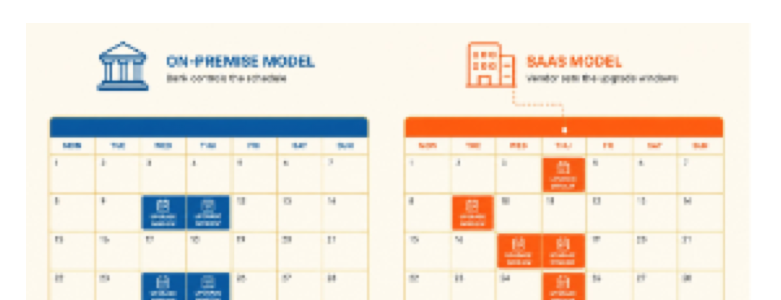
The core banking system rarely operates in isolation. Mobile banking, internet banking, SWIFT connectivity, ATM switches, and internal risk systems all need to talk to the core. In a SaaS model, the API surface area is controlled by the vendor, and versioning decisions are made on the vendor's upgrade cycle.
Banks that have built deep integrations with the on-premise system — often using internal APIs, database-level connections, or batch file formats — face a significant rework to align with the SaaS platform's published integration layer.
Total cost of ownership over five years
The licence and infrastructure savings in year one of a SaaS migration are real. The challenge is that integration rework, middleware development, parallel run costs, staff retraining, and consultant support during transition often shift the economics substantially. Few business cases model these accurately.
A more complete analysis looks at the total cost of ownership over five years, including the cost of every downstream system that must be updated to work with the new API layer.
What successful migrations have in common
Banks that navigate SaaS core banking migrations well share several characteristics. They invest in a detailed pre-migration assessment of every existing customisation and integration. They negotiate contract terms that give them clarity on the upgrade cycle and data residency obligations. And they run a longer parallel operation than the vendor recommends, giving operations teams time to validate that every product variant behaves correctly in the new system.
The organisations that struggle tend to compress the parallel phase and discover edge cases in production.